
The G.U.I.D.E. Framework
Before we fix anything, we need to SEE it.
You've probably tried the usual solutions.
You added another meeting. Bought another software tool. Hired someone to take some of the load. Or just worked harder and pushed through. None of those are bad ideas. And that's usually when you tell yourself, “It's time to document our processes.”
Don't start by writing it down. The friction you're feeling is a symptom, and to find the root cause, you start with one question: how does the work get done today? Make the work visible first. Then your team decides what to solve FIRST. Then we solve it, and keep solving it, until the new way is simply how your team works.
Business Audit
Four 60-minute virtual sessions with your leadership team
In the Business Audit, we look at the core phases of your business and follow how a client moves through each one, milestone by milestone and department by department.
Every step gets one of four scores: Solid, Bottleneck, Breakdown or Blind Spot. The score matters because each problem needs a different fix. A bottleneck means the work runs through one person, so you delegate, train or hire. A breakdown means the standard was never made clear, so you define it. A blind spot means nobody owns it, so you assign an owner. Score it right, and you know which fix to reach for.
Then we check each stage for three things. Is there a Hold point, where someone confirms what has to be true before work moves on? A Huddle, a regular meeting where problems get caught early? A Hub, one place where the information lives? And for every step, one more question: if that person is on vacation, does it still run?
What you walk away with
- Your operation on one page, scored stage by stage
- The three things worth fixing first, ranked by their impact on time, money and your clients
- An owner and a first move for each one
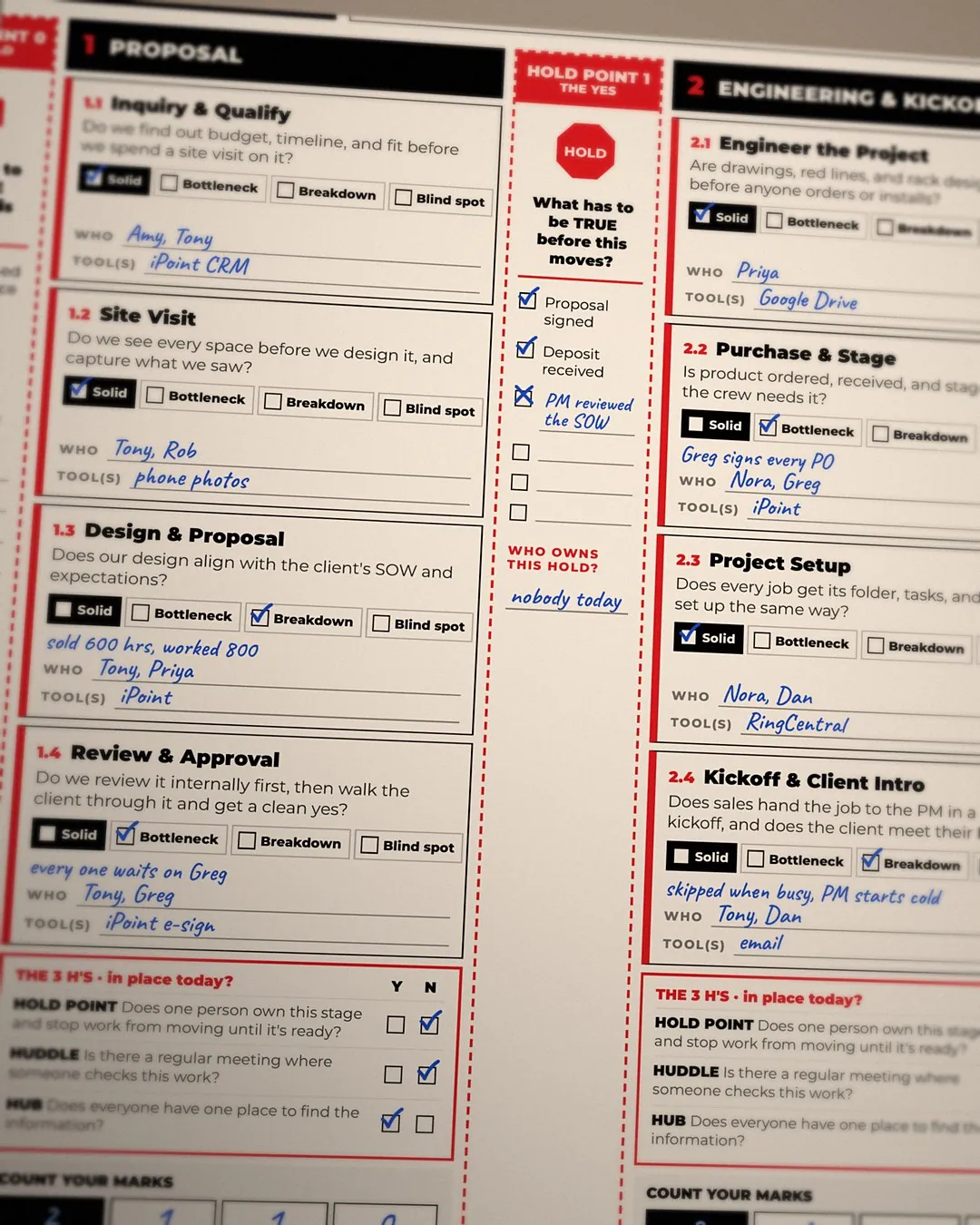
On one Audit, proposals were going out in waves: nothing for days, then ten at once, and clients were complaining about turnaround. It looked like a sales problem. On the map, it scored as a bottleneck. Every site-visit write-up ran through one person, and a 24-to-48-hour target was slipping to four or five days. Different score, different fix.
Strategy Workshop
One or two days in person, built from what the Audit uncovered
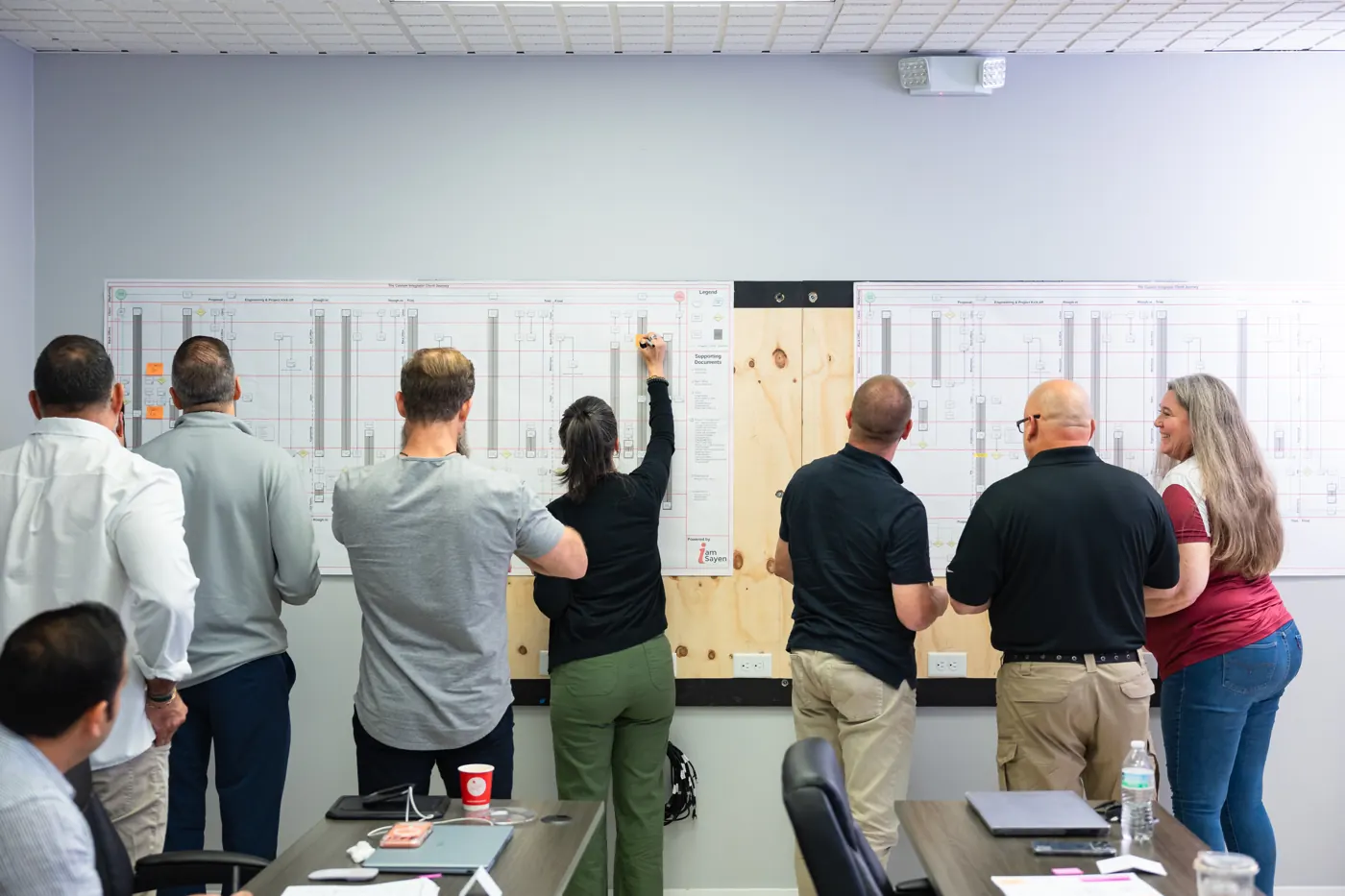
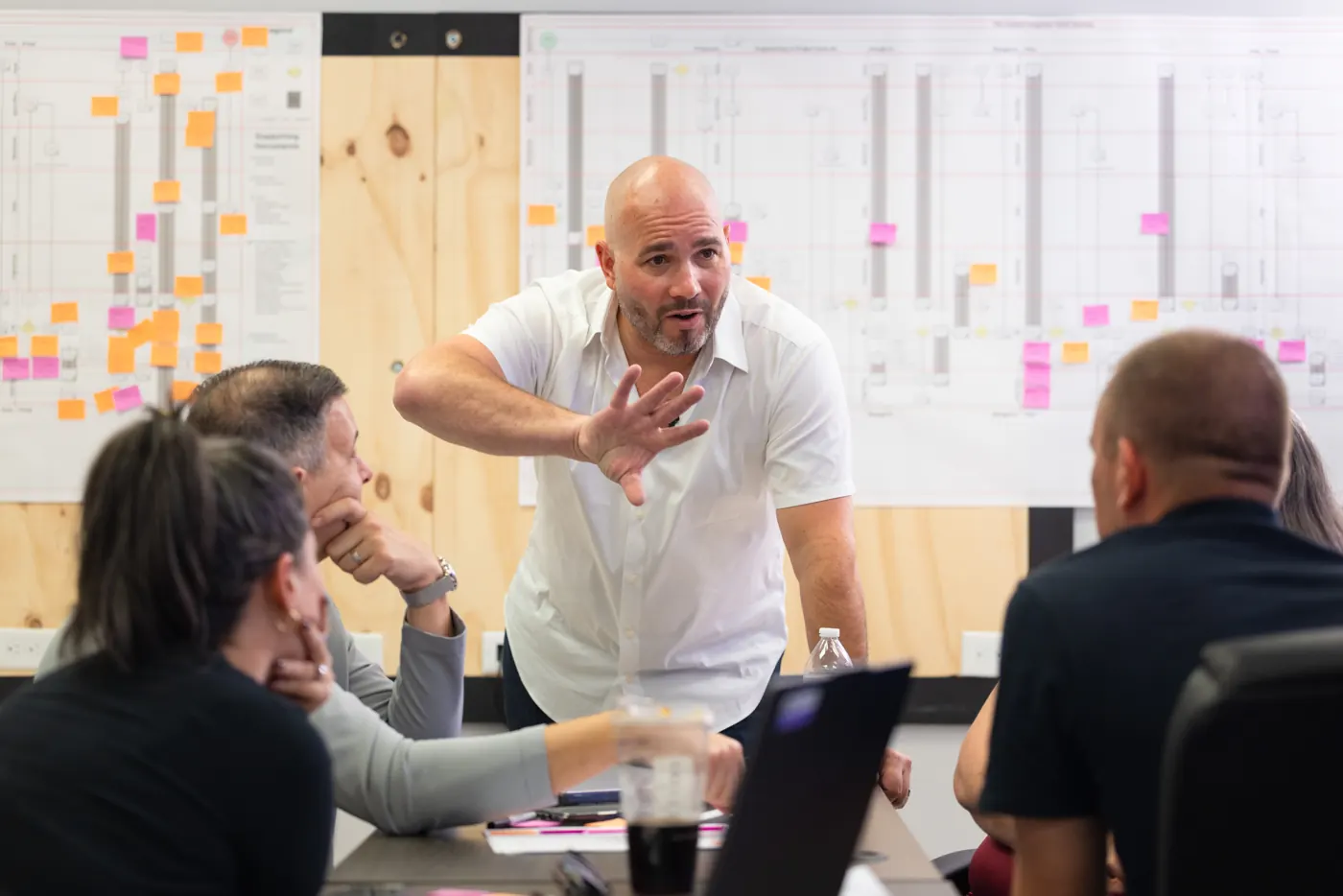
Before the workshop, your team gets a short video from me that sets expectations. Nobody's being graded. They're there to point out the things that make their jobs harder than they need to be. The workshop is for them. On the day, we want everyone in the room who touches the process. The map goes on the wall, and each person puts a sticky note with their name on it wherever the work breaks, isn't clear, or causes them problems later on. Then we go through every note. We're not asking who messed up. We're asking where the process broke, and looking in the mirror.
The notes start to cluster, and leadership sees what the team has been living with. In one workshop, the owner, who was also the main salesperson, looked at the wall and said, “Why are there so many manual steps after we sign a contract? Now that I see it, I understand why they get skipped.” That led to a conversation about cutting the manual steps first, then bringing in automation.
Then we pin your real, current projects to the map, right where each one sits today, and ask whether each problem is one we've already found or something new. By the end of the day, it's all visible, and you can't unsee it. Nobody can say “we never talked about that.”
We wrap up with your team ranking what to fix by effort and impact. They build the plan, so the plan is theirs.
Usually one full day in person. Larger teams may need two.
What you walk away with (editable, and yours to keep)
- Operational Blueprint: your workflow, start to finish
- Responsibility Matrix: who owns every step and every handoff
- Gap Assessment: every friction point, traced to its root cause
- Priority Scorecard: what to fix first, ranked by your team
- Execution Roadmap: who does what, and by when
- Leadership Summary: the short version for decision-makers
In one workshop, a tech mentioned he emails detailed notes at the end of every day. Then someone pointed out that the software already sends everyone a nightly summary of every tech's notes. Someone asked, “Am I the only one reading that?” It got fixed during the break.
Implementation
Six months
The workshop is the fun part. Everybody sees what needs to be fixed. Then they walk back to a desk full of work the next morning, and that's where most improvement efforts quietly die. I learned that the hard way. Early on, I'd hand over the map and the list of gaps and assume the client would take it from there. One owner told me, “I'm more overwhelmed than before we started, because I see everything that needs to be fixed and I want to fix it all at once!”
Change is a process, not an event. We work the top three priorities, then the next three. Every fix has an owner and a defined outcome. We build the SOPs and checklists from what your team identified, adjust roles where they need adjusting, and meet regularly to review what's working and what's still getting stuck. If the same thing breaks more than twice, it's a pattern, and someone has to own it.
“He is still holding us accountable through the next steps and I know that from continued interactions he cares about the success of the organization.”
Adam Zatorski · King Systems LLC
The method underneath
Every engagement follows the same five steps. It's how I look at any business.
- Get Visibility. See how work actually moves, not how it's supposed to.
- Understand Flow. Follow the handoffs between people and steps.
- Identify Gaps. Find where work stops, waits or gets redone, and why.
- Define Standards. Decide the right way, and who owns it.
- Execute with Cadence. Make it stick with owners and a regular review.
Questions I get on every call
How will you make my team follow the process?
I won't, and neither will you, if you hand it to them finished. Your team builds it. Everyone who touches the work is in the room, puts their name on the wall where it breaks, and helps rank what to fix by effort and impact. People follow a process they helped design, and they follow it better when they understand why it exists. One owner put it this way: if they don't understand the system and the why, there's no engagement. They'll do what you ask, but that's it.
“Before our time with you, I feared the team might suspect the company was scrutinizing their work. Instead, they approached the exercise from an angle of collective betterment.”
Jimmy Paschke · Apex Technologies US
How do you make this stick?
The workshop is built to make it stick. The people doing the work are in the room, and every exercise, even the scoring, is designed so everyone sees, and feels, how the problems land on each other. When the whole team feels the pain together, they want to change. Nobody has to be talked into it.
After that, my main job is to hold you accountable to the thing you signed up for: change. In Implementation, we work the top three fixes, then the next three, with an owner for every one and a regular review to keep them moving.
How long does it take?
The Business Audit is four 60-minute virtual sessions. The Strategy Workshop is usually one full day in person; larger teams may need two. You'll leave it with decisions you can act on the next week. Then Implementation runs six months.
Does my whole team need to be in the room?
The more people who touch the process, the better. Ask one person to write it, and you get one person's process. It looks correct on paper and uncovers nothing. With everyone in the room, you surface more blind spots, and you get more buy-in because they were part of it.
In one workshop, the owner found out at a break that the weekly meeting to review the top projects hadn't happened in about six weeks, ever since scheduling changed hands. Leadership wouldn't have found that in a conference room on their own. If there are big-picture decisions only leadership should make, we can plan for that, but the people doing the work belong in the room.
What do we actually walk away with?
Not a giant list of problems. You get your workflow on one page, a clear owner for every handoff, the gaps traced back to their root causes, and a ranked plan for what to fix first. Some fixes are training. Some are decisions you just haven't made yet. Some are a setting in your software. All of them have an owner.
Can you show me the ROI?
Most companies don't have clean enough metrics or structured processes to set measurable improvement goals going in. Sometimes you won't see a measurable impact in six months, but you'll feel it. What clients tell me is that things feel less stressful. Fewer fires, fewer change orders, less of everything running through the owner, and room to take on more work with the same team. If you have numbers you want to track, we'll set a baseline at the start.
Isn't this really an accountability problem?
Sometimes. But before you question the person, question the process. I ask five questions, and I stop at the first no. Was there a process? Is it clear who's responsible? Is it written down where people can find it? Does it still match how the work gets done today? Were they trained on it? If the answer to all five is yes, now it's a choice, and that's an accountability conversation. Until then, good people look bad inside unclear process.
One company had a $20,000 check sitting on the CFO's desk for two weeks because there was no invoice to match it. There was nothing in place for when the payer isn't the client. The person who made invoices did them “when I have extra time.” It all lived in the heads of the early team, and the new hire had asked to be trained. One symptom, three problems. A write-up would have fixed none of them.
We already run EOS. How is this different?
Good. Keep running it. Process is one of the six components of EOS, and an EOS Implementer has to cover all six, so there's rarely time to go deep on any one of them. Process is where I go deep. A lot of companies running on EOS have “document our core processes” as a quarterly rock, and I help them hit it. We make the work visible first, so the processes you document fix the right things and your team actually follows them.
Should we fix our software first?
Process first, software second. Software doesn't fix a broken process; it automates it. I've watched owners about to buy new software realize the tools they already had did the job. They just couldn't see how work moved between them. Once the work is visible, you'll know exactly what to ask AI or your software to do.
“He empowered us to uncover precisely what we needed from our software, setting the foundation for a custom solution tailored to our unique requirements.”
Lorenzo Giles · Innovative Technology Solutions
Do you know what to fix FIRST?
Let's have a 30-minute conversation about where work gets stuck in your business.